
Lightweight panels hold up airplane floors, satellite walls, and racing bodies. They carry serious loads without adding serious weight. It almost sounds too good to be true, doesn’t it? The key lies in intelligent geometry and wise selection of materials. No magic involved. Just physics doing its thing.
The Sandwich Trick
Most durable yet lightweight panels utilize a structure known among engineers as a sandwich structure. A thick, light core sits between two thin, stiff outer layers. Think of it as corrugated cardboard but built with aerospace-grade materials. The face sheets manage tensile and compressive forces. The core in the center keeps the sheets apart and takes the compression. Combined, they make a far stiffer and stronger structure than any single piece. Increasing the core thickness spreads the face sheets apart. This greatly improves stiffness with minimal weight gain. Spacing is more important than many think.
Read More : What Makes a Lightweight Panel Structurally Strong?
Why Honeycomb Cores Work So Well
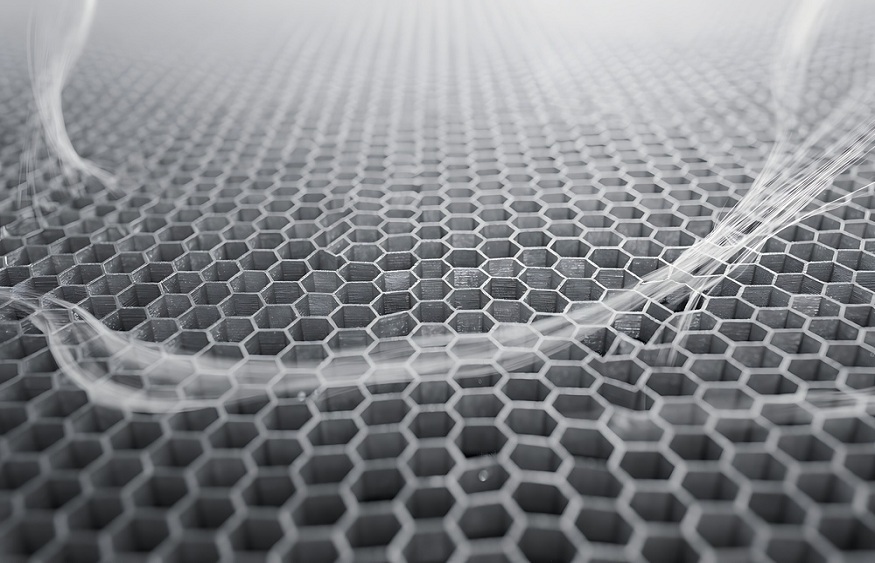
The most popular core material in high-performance panels is honeycomb. It looks exactly how it sounds. Rows of hexagonal cells, just like the inside of a beehive, bonded between two face sheets. That hexagonal shape is not decorative. It is structural genius borrowed straight from nature. Each cell wall shares the load with its neighbors, spreading forces evenly across the entire panel. The result is a core that resists crushing pressure remarkably well despite being mostly open air inside. Honeycomb cores made from aluminum or aramid fiber weigh shockingly little. Some come in under five pounds per cubic foot. Yet they give panels enough rigidity to support heavy equipment or stand up to turbulent aerodynamic forces.
Face Sheets Do the Heavy Lifting
The outer skins matter just as much as the core. Carbon fiber, fiberglass, and aluminum are the go-to choices, depending on the job. Carbon fiber face sheets are stiff and featherlight. Fiberglass costs less and still delivers solid performance. Aluminum works well when the panel needs to handle heat or resist chemical exposure. But here is the catch. The face sheet has to bond tightly to the core underneath. A weak bond between the skin and core is one of the fastest ways for a panel to fail under stress. That bonding step, usually done with a film adhesive during a heated cure cycle, is every bit as critical as the material selection itself.
Shape Matters More Than You Think
This is the part that surprises people. A sandwich panel does not earn its strength mainly from tougher materials. It earns strength from shape and spacing. Doubling the thickness of a panel’s core can triple its stiffness while barely nudging the weight upward. Engineers call this a favorable strength to weight ratio, and it is the whole reason sandwich construction dominates aerospace, marine, and industrial applications. Thin face sheets far apart. A light core in between. Simple concept. Massive payoff.
Where Material Quality Counts
A lightweight panel only performs as well as the materials inside it. Cut corners on the honeycomb or the adhesive, and real-world performance falls apart fast. Axiom Materials has built a respected position among the best honeycomb core manufacturers by producing honeycomb products across a wide range of cell sizes and material types for both aerospace and commercial programs, all backed by AS9100D and ISO 9001:2015 certifications that hold their manufacturing to a genuinely high standard.
Read More : Why Recognition Has Become a Strategic Asset for Modern Business Leaders
Conclusion
Lightweight panels manage something that seems contradictory on the surface. They bear heavy loads while adding almost nothing to overall weight. It’s not about one miracle ingredient. It’s stiff face sheets, a lightweight core, solid bonding, and smart geometry acting together. The lightest panels flying today are also some of the strongest. Not magic. Just good engineering.